Insurance and Safety for Gardening Yeading
Welcome to our overview of how an insured gardening company operates safely and responsibly in Yeading. This page explains the practical measures that insured gardeners put in place to protect your property, staff and the public. Our focus is on clear, verifiable protection: robust public liability insurance, comprehensive staff training, correct personal protective equipment and a structured risk assessment process. These foundations help any insured garden maintenance service deliver safe, reliable results.Public Liability Insurance: Why It Matters
The backbone of every professional gardening service is public liability insurance. As a reputable insured gardening service in Yeading, an appropriate indemnity limit gives homeowners and businesses peace of mind in case of accidental damage or injury. Typical cover for garden maintenance and landscaping work protects against third-party claims for bodily injury, property damage or accidental loss while on site. An insured gardening company will always hold a current certificate of insurance and be able to produce evidence on request to confirm cover for the type of work being carried out. Insurance cover varies with activity: simple garden tidies need different limits than tree work or excavation. Professionals offer tailored insured gardening solutions that match the scale and risk of each job, whether routine lawn care or a full landscape installation. By choosing an insured gardener you reduce personal exposure and ensure that the business can respond to claims without impacting the client.
Staff Training and Competence
Safe gardening is delivered by trained teams. An insured gardener employer invests in continuous staff development, including induction, tool-specific training and qualifications such as NPTC or equivalent for powered equipment. Training records form part of the company’s safety management and are routinely audited to maintain standard practice. Emphasis is placed on correct machine handling, safe lifting techniques and recognition of hazardous plant and substances.Ongoing training also includes on-going toolbox talks, emergency first-aid awareness and specific sessions on working near structures, services and public areas. Strong supervision and mentorship ensure newer staff learn under the guidance of experienced operatives, which reduces on-site incidents and reinforces the insured gardening company’s duty of care.
Risk-based training means employees are prepared for the range of tasks they will face. Regular competency checks and refresher courses ensure that every team member can work safely, maintain plant properly and follow method statements for higher risk jobs. These measures are central to how an insured gardening contractor controls exposure and supports public safety.
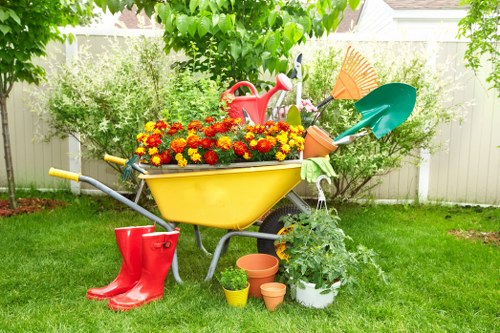 PPE and Safe Equipment UsePersonal protective equipment (PPE) is a visible and essential part of safe garden work. An insured gardening business enforces PPE use through policy and supervision: gloves, durable safety footwear, eye and ear protection, hi-vis clothing and respiratory protection where dust or sprays are present. For tree work, chainsaw chaps and helmets with face protection are mandatory. PPE policies are backed by replacement schedules and fit checks to make sure protection is effective.
Equipment safety goes further than PPE. Safe systems of work cover plant inspection, maintenance records and secure transport of machinery. Power tools are tested and tagged, ladders are inspected, and mechanical equipment is stored to minimise risk. A commitment to this level of care is part of being a responsible, insured gardening company.
Where chemicals or pesticides are used, the insured garden maintenance provider follows COSHH principles: correct storage, use of appropriate PPE and detailed safety data sheets. This approach reduces health risks for staff, clients and the environment and integrates with the company’s liability cover to ensure overall protection.
Risk Assessment Process Every professional, insured gardening service follows a formal risk assessment process before starting work. Typical stages include an initial site survey, identification of hazards, evaluation of potential consequences and the development of proportionate control measures. The output is a clear method statement or work plan that aligns with the insurance cover and the agreed scope of work.
- Site survey: map hazards such as overhead wires, uneven ground and public access routes.
- Risk evaluation: prioritise risks by likelihood and severity, then assign controls.
- Implementation: apply controls such as signage, barriers, traffic management and PPE.
- Review: monitor and adapt controls during the job; record outcomes and incidents.
 Dynamic risk assessments are used where situations change during a job—such as unexpected underground services or changing weather. For higher-risk tasks, the insured gardening company will supply additional documentation like method statements, permits for hot works and qualifications for arboricultural activity. This proactive management reduces the chance of claims and demonstrates a mature safety culture aligned with public liability cover.
 In summary, choosing an insured gardening company in Yeading means selecting a provider who pairs adequate public liability insurance with structured staff training, enforced PPE standards and a rigorous risk assessment process. These combined measures protect clients, employees and the public and ensure that work is completed professionally and safely. When contractors prioritise these elements you benefit from reliability, transparency and the reassurance that comes with fully insured garden maintenance and landscaping services.